Search results for tag #selfhosting
![[?]](https://media.infosec.exchange/infosec.exchange/accounts/avatars/000/070/798/original/d20ead2f85c91066.jpg)
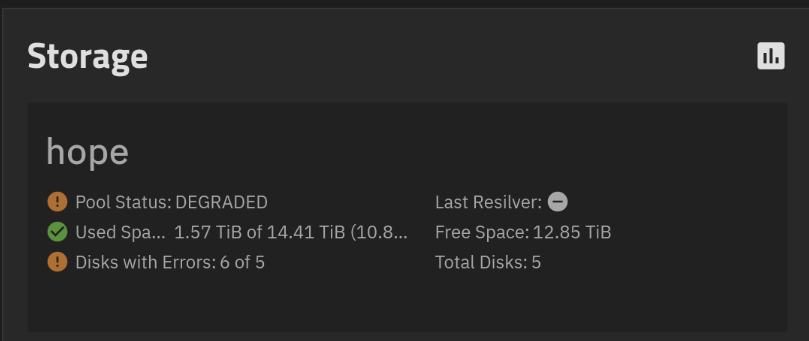
The repair of the #NAS continues. I suspect this is not a good sign.
#homelab #truenas #selfhosting
Alt...
Screenshot of a TrueNAS storage report. It says "Pool Status: DEGRADED
Used Space:1.57 TiB of 14.41 TiB (10.88%) Disks with Errors: 6 of 5. Total Disks: 5" I have more disks with errors than I have disks? There are seven physical drives in this system.
![[?]](https://mastodon.neilzone.co.uk/system/accounts/avatars/000/000/003/original/1686a2608fa9766e.jpg)
Even newer blogpost:
# Automating local backups of UniFi OS Server on Linux with uos-backup
Fixing the gaps left by Ubiquiti with python and systemd.
https://neilzone.co.uk/2026/08/automating-local-backups-of-unifi-os-server-on-linux-with-uos-backup/
New blogpost:
# Migrating my self-hosted UniFi controller from Network Manager to UniFi OS Server
It worked better than I was expecting, but that’s mainly because my expectations were very low.
Sufficient things are broken (for me, anyway) for it to be a pain.
so the wisdom of crowds is batting 500. 2 right, 2 wrong. The answers were:
- 33 drives
- 64TB
- 12.6 kg
- 18 Gb
That 18GB drive was the mail server’s only drive for like 20 years. Quantum Atlas V SCSI.
I am glad to say that I have more drives working than I have dead. 32 in the rack and 7 inside in the NAS (not counting random laptops and such)
#selfhosted #selfhosting #homelab
First off, how many drives do you think are in the box? Since the right answer has to be in the list, I put a lot of options in to raise the difficulty a bit.
#selfhosting #homelab #selfhost
| 25: | 1 |
| 27: | 8 |
| 29: | 7 |
| 31: | 5 |
| 33: | 15 |
| 35: | 9 |
| 37: | 10 |
Ok. It's always fun to post stuff like this here, because there will be some #selfhosting afficionado who replies "You are like little baby. This is what real man has." But here goes.
When hard drives die on me, I don't throw them away and I don't take them to the county e-waste dropoff. There's a company nearby that will take them, certify that they destroy them, and dispose of the waste properly. So I have this box in my garage that accumulates dead drives until I'm ready to go drop them off. It's getting kinda full.
When I went to add a couple to the box tonight, I took an inventory. Wanna guess some stats about the box of dead drives? Remember that some of these are old enough to vote. Others are old enough to walk to school. None are in diapers.
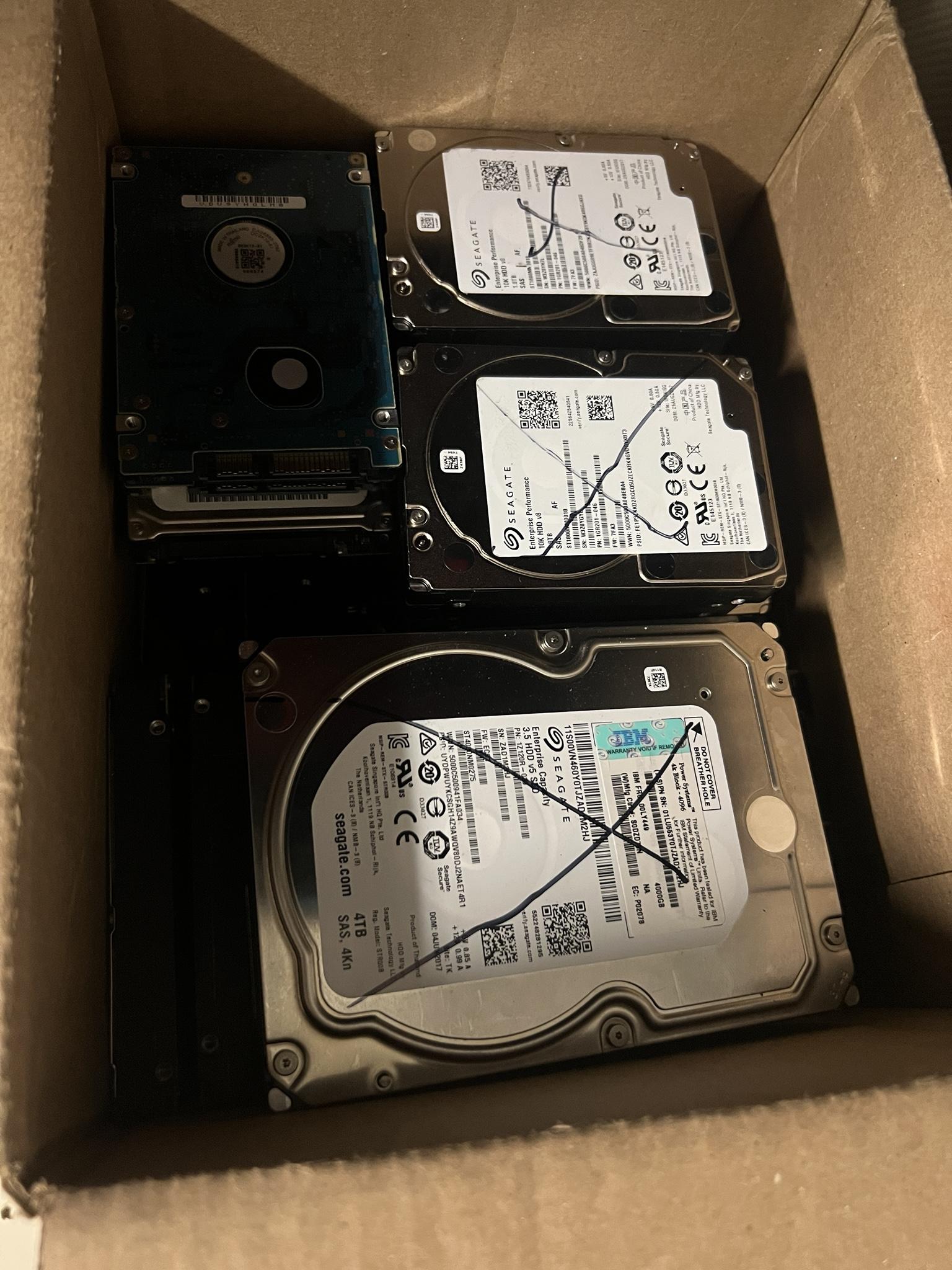
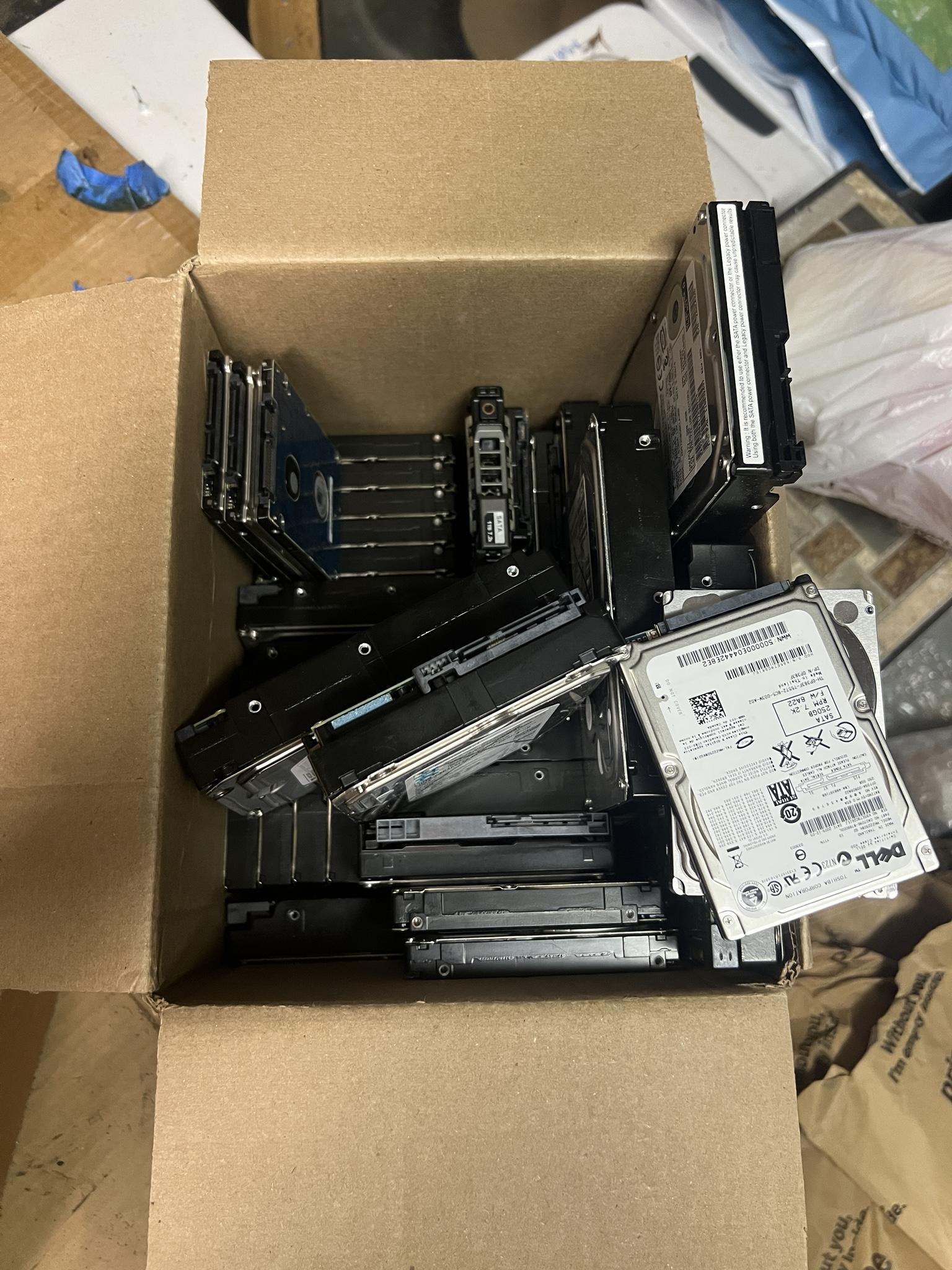
Here are some fun polls related to all my dead drives. First, a couple photos. Polls will be in replies.
Alt...
Photo of a cardboard box with a bunch of hard drives neatly stacked. On top are 2 2.5 inch drives that are Seagate 1.8 terabytes and a Hitachi SAS drive that is 4 terabytes.
Alt...
A more jumbled photo of the same box of hard drives. In this case you can see a wide variety of 2.5 inch drives and 3.5 inch drives. They're at angles and stuff to make it a bit easier to see just what the variety is like.
![[?]](https://kolektiva.social/system/accounts/avatars/111/187/426/261/389/783/original/6180972d45358593.jpeg)
RE: https://scholar.social/@gedankenstuecke/117146471046158781
The nonprofits did everything #Microsoft asked and still got wiped so the company could free up storage for #AI. That same AI and cloud capacity is what Microsoft sold to the #Israeli military to store mass surveillance of #Palestinians and run the targeting systems used to kill people in #Gaza. So a children's charity loses 500GB of irreplaceable data, and the room it vacated helps power a war machine. That's the trade Microsoft made, and it tells you exactly where you rank when you're depend on handouts from a USA corporation.
#microsoft #ai #israeli #palestinians #gaza #gazagenocide #selfhosting
Oof, just deleting all of that data with seemingly no way for some of the affected orgs to get their data back is just horrible.
Microsoft made a quiet change to a popular software grant. Small nonprofits lost everything.
https://slate.com/technology/2026/08/microsoft-software-nonprofit-data-delete.html
![[?]](https://cdn.masto.host/scholarsocial/accounts/avatars/000/116/560/original/a23e2e15732b7195.jpg)
![[?]](https://media.beige.party/accounts/avatars/115/591/845/251/066/522/original/46ea64281bc656da.jpg)
Can I move a playlist/collection from one drive target to another or something along those lines in plex?
My network drive is not playing nice, want to not waste more time creating new lists for this backup external drive I'm using instead now.
Maybe this works better in Jellyfin, which I haven't checked out yet?
I have lifetime plex pass but the system is kind of not flawless.
I'm using this to listening to music remotely primarily lately.
![[?]](https://media.infosec.exchange/infosec.exchange/accounts/avatars/117/061/201/134/387/481/original/6340136f95b53e37.jpeg)
I received an email from Oracle last night stating that the always-free tier had been downgraded or stuff similar to that. Being sleepy-eyed, I logged in and deleted my instance. All my self-hosted services are gone, and I never implemented a backup system for this VPS.
![[?]](https://gts.fname.ca/fileserver/01CPBFDWE48A5S8XXS26556EDA/attachment/original/01KZKY0VCNWB2YY5XP2KHENY90.gif)
 (Testing GoToSocial) [
First attempt: total failure. There’s a mismatch between the version of the database created by pg-dump and the pg_restore in the db container. Can’t figure out how to install the correct version in the container.
Taking a break…
Jitsi Meet is a free open source self-hostable video conference platform, intended as an alternative to Zoom etc. More info:
It can be used through the web or mobile apps.
Self-hosting is possible through @yunohost at https://apps.yunohost.org/app/jitsi and there are also manual self-hosting instructions at https://jitsi.github.io/handbook/docs/devops-guide
There's a Jitsi managed hosting service for large organisations at https://jaas.8x8.vc
Update:
So this morning I was successfully able to jump my GTS container from my Synology NAS to a container on my main server box. It worked no problem this time, so I suspect my hypothesis about getting limited by LetsEncrypt was correct; after letting it cool down for a couple of days it’s started up no problem.
I’m expecting a noticeable performance bump as the new hardware has a lot more torque. Performance on the NAS was fine, until it started doing disk-intensive stuff which introduced quite a bit of lag.
Amazon's Twitch is now quietly feeding its streamers' content into GenAI/LLM by default 🤮 (Source: https://kotaku.com/twitch-is-now-using-your-content-to-train-amazon-ai-models-and-has-hidden-the-option-to-opt-out-2000723891)
If you want an alternative where you have total control and ownership of your own streams, @owncast is worth a look:
🌱 https://owncast.online (website)
🌱 @owncast (account)
OwnCast accounts can be followed from Mastodon etc. People who follow you will see in their timelines when you go live, and can click straight through to your stream.
Update on the #GoToSocial project: it definitely seems to stall out when the disk I/O ramps up on the NAS due to a scheduled backup task. I tried relocating the GTS instance to container on a different machine, and then to a VM on a different machine but both attempts failed; something to to with LetsEncrypt. I suspect maybe I got rate-limited?
Anyway, it’s back under the NAS for now. I did some tweaking of the timing of the backup jobs so we’ll see what happens tomorrow morning. 🤷♂️
You can create your own alternative to Amazon Goodreads by self-hosting BookWyrm. It federates with other BookWyrm servers so you can share reviews etc, and BookWyrm accounts can also be followed from Mastodon etc. More info at:
You can follow the project account at:
BookWyrm is available through YunoHost at https://apps.yunohost.org/app/bookwyrm and a manual installation guide is in the documentation at https://docs.joinbookwyrm.com
UnifiedPush is a free open source project to give people more control over their push notifications, including the option of self-hosting your own notification server. If you're a techy person, you can find out more at:
You can follow the project at:
![[?]](https://critters.gay/files/0fd18417-ccb3-426a-9714-436981af70c1.png)
ok sysadmin side of fedi, what do you recommend for lightweight wikis? i want a wiki or wiki-like service with a small memory footprint, user-submitted html, and some sort of access control so you can make a page which is only editable or viewable by a certain group. im looking into bookstack and wiki.js, they both seem usable but with different issues. bookstack is opinionated in ways i disagree with (all links are absolute links, all pages are contained within a book-and-shelf hierarchy, non-admins cannot create protected areas). wiki.js is a little bit better but it seems to be in rewrite hell so i'm worried i'd be unable to get a stable version. my use case is that i want to make a playground where people can edit pages together or share them privately, to host for a small (<10) group of friends. bonus points if its memory efficient so i can add this to a pi-like server at some point.
If you're into photography, there is a free open Flickr-style photography platform which you can host yourself called Vernissage. It also has Fediverse compatibility so people can follow Vernissage accounts from Mastodon, Pixelfed etc. More info at:
You can follow at:
For techy people who want to install their own Vernissage manually, docs are at:
🌱 https://docs.joinvernissage.org/documentation/vernissageserver
#SelfHosting #Fediverse #ActivityPub #Flickr #Alternatives #Photography
![[?]](https://aseachange.com/fileserver/01ENCW3D083ATDAP5WGJEMSJC8/attachment/original/01JG469Y8X2DXVNGTWEZ8BPAGX.jpeg)
Come join me and @Gina in Luxembourg this October!
#OSCL26 (Open Source Conference Luxembourg) has a brand new track devoted to “Decentralized Technologies for Digital Sovereignty”:
🔗: https://conference.opensource.lu
We are looking for speakers interested in discussing these topics:
- Federated technologies in the public sector
- Decentralized platforms for video, chat, communications, code, etc.
- Fediverse successes and challenges
- Self-hosted solutions for individuals and institutions
- Interoperability for resilience
Apply here:
🔗: https://pretalx.com/open-source-conference-luxembourg-2026/cfp
The conference takes place on Wednesday October 7th in Belval, Luxembourg.
Please share! 🚀
#Fediverse #FediAdvocacy #conferences #OpenSource #FOSS #FLOSS #TheFutureIsFederated #selfhosting #interoperability #DigitalSovereignty #activism
![[?]](https://cdn.masto.host/indiewebsocial/accounts/avatars/112/536/017/792/352/435/original/a87e9128d6303e02.png)
Why do I run FreeBSD for my home servers // Mathieu Aumont
![[?]](https://cdn.masto.host/socialgrowyourownservices/accounts/avatars/107/729/744/625/286/769/original/81f869582bb4abda.jpeg) Grow Your Own Services 🌱 » 🌐
Grow Your Own Services 🌱 » 🌐
@homegrown@social.growyourown.services
HedgeDoc is a free open source collaborative markdown editor. It's web-based and you can self-host it. (Project previously known as CodiMD.)
More info at:
You can follow at:
Manual self-hosting instructions are at:
Grow Your Own Services 🌱 » 🌐
@homegrown@social.growyourown.services
Wallabag is a free open source article-saving platform and apps, similar to Pocket. It lets you save articles from around the internet to read later. More info at:
You can self-host your own Wallabag:
🌱 https://wallabag.org/self-hosting
If you don't want to self-host, you can sign up for an account on their paid service:
There are Wallabag apps for all major reading platforms: https://wallabag.it/en/applications
![[?]](https://fsn1.your-objectstorage.com/drum/accounts/avatars/109/337/709/103/817/254/original/13fc1022b4126907.jpg)
Excitingly (for me) I now have a 1tb hard drive dedicated solely to my Navidrome library. It was only using 150gb of my existing 1tb internal drive, but that's storage that's being shared with Jellyfin and Immich, so everything I add to it gives me storage anxiety.
I'll probably still fanny about converting FLAC > 320kbps M4A to conserve space, because some habits are hard to break and storage anxiety is difficult to shake - particularly in this economy. But given that I've been using Navidrome for around 8 months and I've only added 20gb to my existing library, it's gonna take me a while to need more than 1tb.
Grow Your Own Services 🌱 » 🌐
@homegrown@social.growyourown.services
Self-hosting people!
Do you have suggestions for directories of self-hostable free open source software?
So far I've got the Awesome list at https://awesome-selfhosted.net but wondered if there are any others you would recommend?
Mobilizon is a Fediverse-compatible free open source events platform, developed as a libre alternative to Facebook Events. You can find out more at:
You can follow the official account at:
If you're a techy person there are manual installation instructions for self-hosting at:
🌱 https://docs.mobilizon.org/3.%20System%20administration/install
#SelfHosting #CommunityHosting #Fediverse #ActivityPub #FacebookEvents
![[?]](https://cdn.masto.host/socialgrowyourownservices/accounts/avatars/111/589/347/315/890/061/original/e603733b53591171.png)
If you're interested in starting your own Mastodon server or other kinds of online services, you might want to check out my other website:
➡️ https://growyourown.services
I've just revamped the site to feature options for all tech skill levels (including none!). You can follow this account for the site's latest updates:
➡️ @homegrown
Here's an easy-to-understand tutorial from the site about creating your own Mastodon server:
➡️ https://growyourown.services/making-your-own-mastodon-server-in-10-steps
I've overhauled the Grow Your Own Services website, so it provides more info on different options for running your own online services:
🌱 https://growyourown.services
I hope the site is clearer than it was before 🙂
All kinds of feedback welcome!
![[?]](https://b0nfire.xyz/social/firekeeper/s/avatar-d323ced33338a1f5caf2c74c70bb3b65.jpeg)
cross-posted from: https://lemmy.world/post/49778
https://sh.itjust.works/post/63857889
Check your instances and blocklists, y'all.
#mastodon #lemmy #tesseract #selfhosting #authoritarianism #lemmy #piefed
![[?]](https://files.mastodon.social/accounts/avatars/109/246/411/862/197/824/original/1586f1125b5f9786.jpg)
Good morning Fedi friends,
I have been feeling a rising anxiety over the state of the open web and the fediverse - after seeing efforts by politicians all over the world (in Europe too!) to introduce age verification laws for social media.
My way of coping?
Teaching people how to self-host their own Fediverse profile (using the superb #GoToSocial) via #YunoHost.
Chapter 1 in this series is available here: