Search results for tag #literature
![[?]](https://cdn.masto.host/zirkus/accounts/avatars/111/192/373/629/540/829/original/9ff4f5b9781a0e3a.jpg)
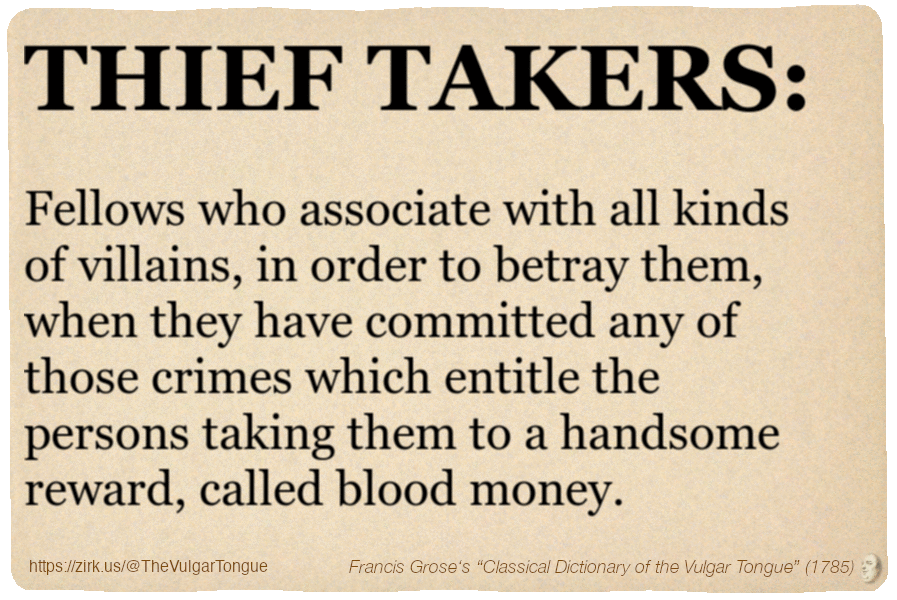
THIEF TAKERS. Fellows who associate with all kinds of villains, in order to betray them, when they have committed any of those crimes which entitle the persons taking them to a handsome reward, called blood money.
A selection from Francis Grose’s “Dictionary Of The Vulgar Tongue” (1785)
--
#books #literature #dictionaries #history #society #language #slang @histodons
Alt...
Image imitating a page from an old document, text (as in main toot):
THIEF TAKERS. Fellows who associate with all kinds of villains, in order to betray them, when they have committed any of those crimes which entitle the persons taking them to a handsome reward, called blood money.
A selection from Francis Grose’s “Dictionary Of The Vulgar Tongue” (1785)
![[?]](https://files.mastodon.social/accounts/avatars/115/799/874/970/791/651/original/bc92733c279a8f7c.jpg)
Estás aquí. Poema de Rolando Enrique Rosales Murga. Sus poemas en su voz. #bookstagram #bookstagrammer #bookstagramespañol #reseñaliteraria #Libros #gothic #Kindle #kindle #explorepage #amazonkdp #amazonkindle #gothicstyle #poetry #poemas #verso #lirica #gothicfashion #literature #poetry #viral #viralvideo #viralvideos #ViralPost
I No Longer Creep. Poem by Rolando Enrique Rosales Murga. His poems in his own voice. #bookstagram #bookstagrammer #bookstagramespañol #reseñaliteraria #Libros #gothic #Kindle #kindle #explorepage #amazonkdp #amazonkindle #gothicstyle #poetry #poemas #verso #lirica #gothicfashion #literature #poetry #viral #viralvideo #viralvideos #ViralPost
Ya no repto. Poema de Rolando Enrique Rosales Murga. Sus poemas en su voz. #bookstagram #bookstagrammer #bookstagramespañol #reseñaliteraria #Libros #gothic #Kindle #kindle #explorepage #amazonkdp #amazonkindle #gothicstyle #poetry #poemas #verso #lirica #gothicfashion #literature #poetry #viral #viralvideo #viralvideos #ViralPost
Literary Grove. Poem by Rolando Enrique Rosales Murga. His poems in his own voice. #bookstagram #bookstagrammer #bookstagramespañol #reseñaliteraria #Libros #gothic #Kindle #kindle #explorepage #amazonkdp #amazonkindle #gothicstyle #poetry #poemas #verso #lirica #gothicfashion #literature #poetry #viral #viralvideo #viralvideos #ViralPost
Soto literario. Poema de Rolando Enrique Rosales Murga. Sus poemas en su voz. #bookstagram #bookstagrammer #bookstagramespañol #reseñaliteraria #Libros #gothic #Kindle #kindle #explorepage #amazonkdp #amazonkindle #gothicstyle #poetry #poemas #verso #lirica #gothicfashion #literature #poetry #viral #viralvideo #viralvideos #ViralPost
You Are Here. Poem by Rolando Enrique Rosales Murga. His poems in his own voice. #bookstagram #bookstagrammer #bookstagramespañol #reseñaliteraria #Libros #gothic #Kindle #kindle #explorepage #amazonkdp #amazonkindle #gothicstyle #poetry #poemas #verso #lirica #gothicfashion #literature #poetry #viral #viralvideo #viralvideos #ViralPost
![[?]](https://files.mastodon.social/accounts/avatars/114/456/143/575/897/492/original/c92d5689cb2b6023.jpg)
Painting by David A Hardy (1974). Called Artificial Planets.
https://imgur.com/gallery/painting-by-david-hardy-1974-called-artificial-planets-X4uy4Ye
#painting #paint #illustration #drawing #draw #sciencefiction #scifi #space #planets #illustrator #retro #vintage #cover #art #culture #history #book #literature #graphicart #davidahardy

Alt...
Painting by David A Hardy (1974). Called Artificial Planets.
![[?]](https://sbonline.nyc3.digitaloceanspaces.com/accounts/avatars/113/495/849/866/199/320/original/4f5084d408b1c280.jpg)
Gay Girl Prayers by Emily Austin #books #literature #dedication

Alt...
FOR ANYONE TAUGHT THEY WERE GOING TO HELL
![[?]](https://bookstodon-files.web.thunderhost.net/accounts/avatars/113/948/505/269/996/580/original/9b500ff2b11d8e9c.png)
Born this day: 06/24/1915 Fred Hoyle (d. 08/20/2001)
Fred Hoyle was an English science fiction author of The Black Cloud, Ossian's Ride, A for Andromeda and others...
https://en.wikipedia.org/wiki/Fred_Hoyle
Please BOOST!
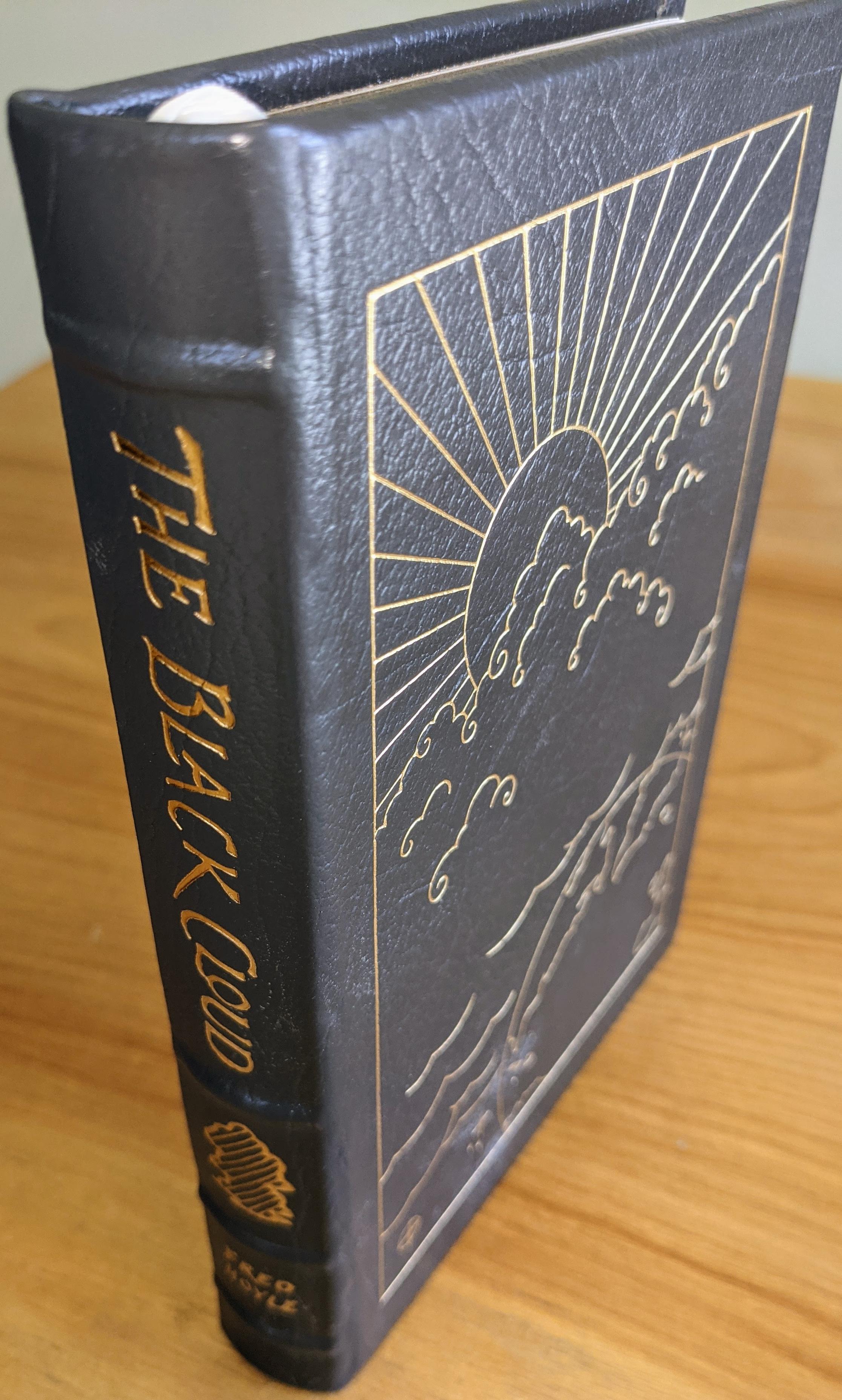
SPECIAL COLLECTORS EDITION of The Black Cloud by Fred Hoyle
https://astralcomputing.com/books/the-black-cloud-hoyle-easton-press
or see the full collection here:
#Literature #SciFi #ScienceFiction #books #bookstodon #coverart #bookart #bookcovers
#FredHoyle
@books @scifi @Scifiart @sciencefiction
Alt...
THE BLACK CLOUD by Fred Hoyle, a Collector's Edition from the Masterpieces of Science Fiction Collection by The Easton Press, issued as a limited run. The volume is bound in full grey leather with a hubbed spine, the leather softly grained with a fine, lightly creased texture and a deep charcoal-grey tone. The title, THE BLACK CLOUD, runs vertically up the spine in 22k gold stylized script; below it, set between raised hubbed bands, sits a small 22k gold emblem of a stylized cloud, and near the foot the author name FRED HOYLE appears in 22k gold. The front cover is framed by a thin 22k gold rule border and carries original artwork by Richard Powers, rendered as fine 22k gold line-work on the dark leather ground: a rising sun, its many straight rays fanning outward, partially eclipsed by a large dark cloud of curling gold outlines, with further stylized clouds and rolling wave-like forms toward the lower right. The page block is printed on acid-neutral, archival paper and finished with gilded edges. The binding features Smyth sewing and concealed muslin joints, and the inside front cover holds a pristine bookplate. A single-owner copy from a private collection, it is accented throughout in 22k gold and has always been stored in a dust-free bookcase in a dry climate. The condition is pristine, as-new, and unread.
Alt...
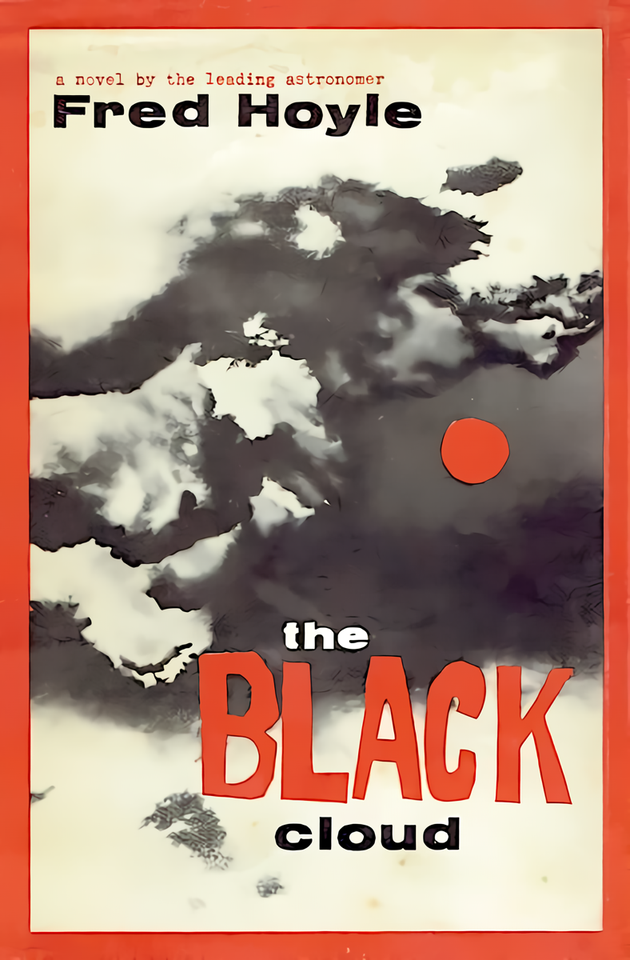
The book cover for "the BLACK cloud" by Fred Hoyle, with cover art by Desmond Skirrow.
The title, "the BLACK cloud", is positioned in the lower half of the cover. "the" is in small, white, lowercase, sans-serif font. "BLACK" is in a large, bold, red, uppercase, sans-serif font. "cloud" is in small, black, lowercase, sans-serif font.
The author's name, "Fred Hoyle", is located at the top of the cover in a large, black, bold, sans-serif font. Above the name, a smaller line of text in a red, lowercase, sans-serif font reads, "a novel by the leading astronomer".
The overall scene features a dramatic, high-contrast sky filled with large, dark, swirling clouds. The clouds are a deep charcoal or black color and appear thick and textured, with irregular, jagged edges. They are set against a bright, off-white or pale cream background, creating a stark, atmospheric contrast. A solid, bright red circle, resembling a sun or a planet, is positioned on the right side of the cover, partially obscured by the dark clouds.
The color palette is limited and striking, consisting of white, black, charcoal, and a vibrant red. The background is a flat, pale cream color. The lighting is stark and dramatic, with the bright white areas contrasting sharply with the dark, heavy clouds. The texture of the clouds appears somewhat grainy or mottled, adding to the sense of movement and turbulence. The entire cover is enclosed within a thick, solid red border.
![[?]](https://files.mastodon.social/accounts/avatars/001/287/672/original/7377c2bd0ab16b03.jpg)
"2150: Un relato del frente.Éramos los últimos en el Sahara. Los rojos ateos rompieron 50 años de paz. Mientras sus tanques gigantes avanzaban, di la orden final...
https://fictograma.com/d/3314-2150-un-relato-del-frente
Era solo un timbre en Benavídez. Fui a casa de un viejo amigo y encontré todo vacío. Al final del pasillo, un espejo negro. No reflejaba mi cara. Del otro lado, su familia golpeaba...
https://fictograma.com/d/3315-el-espejo-de-ebano
"El Quijote de la Mancha, Cap. 12": Capítulo 12: El pastor muerto de amor. Mientras curan a Don Quijote, llega Pedro con noticias: el estudiante...
https://fictograma.com/d/3317-el-ingenioso-hidalgo-don-quijote-de-la-mancha-parte-i-capitulo-12
"El indio": "Yoloxóchitl 🌸
Una joven con dolor de corazón. El brujo ve en el alumbre una figura de corazón y cuenta la leyenda: la princesa que murió de...
https://fictograma.com/d/3318-el-indio-segunda-parte-yoloxochitl-gregorio-lopez-y-fuentes
Hamlet": La Ratonera ha funcionado 🔥
El rey se levanta como alma que lleva el diablo al ver el veneno en el oído.
Mi madre jura no casarse otra vez… claro, como...
https://fictograma.com/d/3320-hamlet-acto-3-escenas-de-la-12-13-14-15-16-17-18-y-19
"Un demonio débil unificó a su raza y fundó un reino... hasta que un ser sin rostro lo redujo a cenizas. Eras después, un hombre muere de cáncer y despierta como una niña demonio de ..."
https://fictograma.com/d/3319-el-alma-que-la-muerte-rechazo-re
Un niño y un viejo sin techo se hacen amigos. El pequeño le lleva pan duro y Coca-Cola. El viejo, entre mitos y locuras, le cuenta historias. Hasta que un...
https://fictograma.com/d/3321-mi-amigo-don-evaristo-coleccion-de-cuentos-fantasticos-70degc
"El público del Gran Teatro aplaudía extasiado cada noche, ignorando que el terror más puro se ocultaba detrás de la partitura de Mozart. Cuando clavé la daga real en el pecho de la Reina de la…
https://fictograma.com/d/3322-el-eco-de-la-venganza
Un timbre en Benavídez. Fui a casa de un viejo amigo y encontré todo vacío. Al final del pasillo, un espejo negro. No reflejaba mi cara. Del otro lado, su familia golpeaba...
![[?]](https://files.mastodon.social/accounts/avatars/114/048/194/944/023/530/original/3a6b93b37c67427d.png)
The London Séance Society by Sarah Penner #books #literature #dedication

Alt...
For my big sister, Kellie.
(And for you, Mom,
After all, you were the first to say,
"Let's go to a séance...")
![[?]](https://files.mastodon.social/accounts/avatars/115/090/106/266/289/375/original/8242bbceb53d91ce.jpg)
"2150: Un relato del frente.Éramos los últimos en el Sahara. Los rojos ateos rompieron 50 años de paz. Mientras sus tanques gigantes avanzaban, di la orden final...
https://fictograma.com/d/3314-2150-un-relato-del-frente
Era solo un timbre en Benavídez. Fui a casa de un viejo amigo y encontré todo vacío. Al final del pasillo, un espejo negro. No reflejaba mi cara. Del otro lado, su familia golpeaba...
https://fictograma.com/d/3315-el-espejo-de-ebano
"Un demonio débil unificó a su raza y fundó un reino... hasta que un ser sin rostro lo redujo a cenizas. Eras después, un hombre muere de cáncer y despierta como una niña demonio de 4 años en una aldea..."
https://fictograma.com/d/3319-el-alma-que-la-muerte-rechazo-re
![[?]](https://files.mastodon.social/accounts/avatars/115/961/306/514/488/543/original/316b5ad0c51a0c78.jpg)
The Football: The Amazing Mathematics of the World's Most Watched Object by Étienne Ghys #books #literature #dedication

Alt...
For Guillaume, a football fan,
and perhaps a bit less a fan of geometry...
This little book may make him look at footballs differently, and see the beauty in them!
![[?]](https://s3.eu-central-2.wasabisys.com/mastodonworld/accounts/avatars/116/535/267/982/042/154/original/068d867f64fff3ec.png)
=> no ai included - do you want one?
#technology #writers #machines #literature #authors #writing #advertisement #business #companies
Alt...
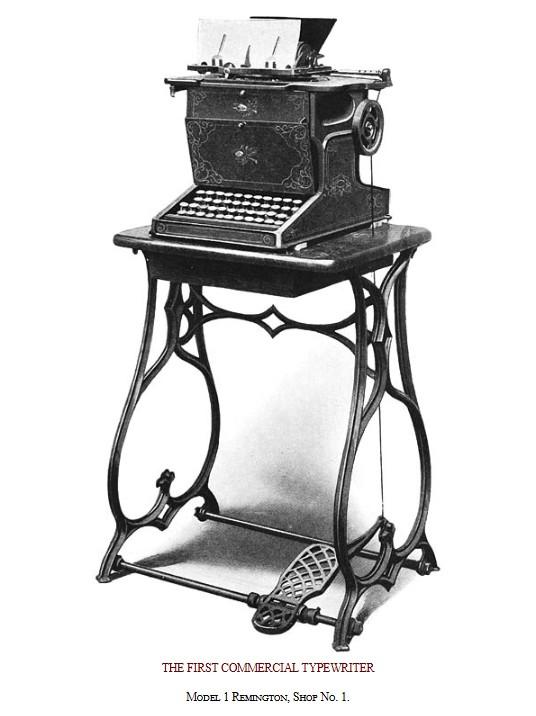
First commercial typewriter.
![[?]](https://media.mastodon.scot/accounts/avatars/109/285/896/512/482/891/original/68bc6eea8b007487.png)
In 1881 the New York Times, reviewing Helen Kendrick Johnson’s OUR FAMILIAR SONGS & THOSE WHO MADE THEM, asserted that no song was “more glorious”, & that once Burns’s poem had been set to the tune of “Hey, Tuttie Tatie”, it “marched through the land forever, loud, & triumphant”
4/5
#Scottish #literature #Bannockburn #BattleofBannockburn #history #18thcentury #RobertBurns #poem #poetry #song #music #19thcentury

Alt...
Book cover: a late nineteenth-century book cover, somewhat scuffed. The cover is a brownish-yellow. A gold medallion showing four men in profile is framed by a curved horn and backed by two pipes. The title is
OUR FAMILIAR SONGS
AND THOSE WHO MADE THEM
Here is Dick Gaughan performing “Scots Wha Hae”, to an audience that includes Dr Maya Angelou – from the documentary ANGELOU ON BURNS (first shown on BBC2, 1996)
5/5
https://www.youtube.com/watch?v=qx8hEoJNVdM
#Scottish #literature #Bannockburn #BattleofBannockburn #history #18thcentury #RobertBurns #poem #poetry #song #folksong #MayaAngelou
PS – the whole of ANGELOU ON BURNS is currently available to watch on the BBC iPlayer
https://www.bbc.co.uk/programmes/m0013vcs
#Scottish #literature #18thcentury #RobertBurns #poem #poetry #MayaAngelou
PPS – if you can’t watch the documentary on the iPlayer, it’s also on YouTube:
https://www.youtube.com/watch?v=wwbuCL-Osh8
#Scottish #literature #18thcentury #RobertBurns #poem #poetry #MayaAngelou
Here lies our land: every airt
Beneath swift clouds, glad glints of sun,
Belonging to none but itself…
—Kathleen Jamie, “Here lies our land”
A poem commissioned to mark the 700th anniversary of the Scottish victory at Bannockburn – won #OTD, 24 June, 1314 – & inscribed on the Bannockburn monument
#Scottish #literature #poem #poetry #Bannockburn #BattleofBannockburn

Alt...
Here lies our land
Kathleen Jamie
Here lies our land: every airt
Beneath swift clouds, glad glints of sun,
Belonging to none but itself.
We are mere transients, who sing
Its westlin’ winds and fernie braes,
Northern lights and siller tides,
Small folk playing our part.
‘Come all ye’, the country says,
You win me, who take me most to heart.
Kathleen Jamie discusses “Here lies our land” for the BBC’s Poetry Postcards – available on BBC Sounds
https://www.bbc.co.uk/programmes/p021bnm7
#Scottish #literature #poem #poetry #Bannockburn #BattleofBannockburn
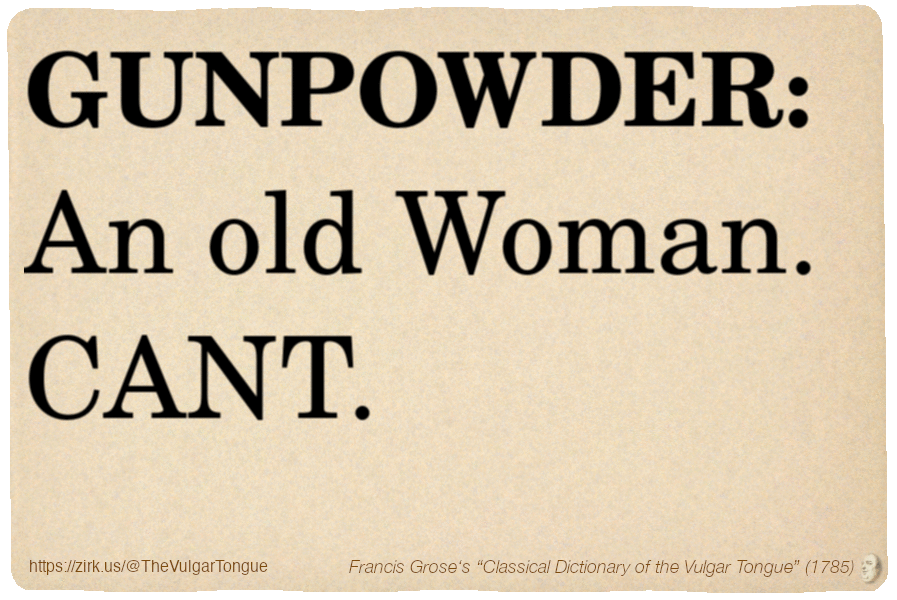
GUNPOWDER. An old Woman. CANT.
A selection from Francis Grose’s “Dictionary Of The Vulgar Tongue” (1785)
--
#books #literature #dictionaries #history #society #language #slang @histodons
Alt...
Image imitating a page from an old document, text (as in main toot):
GUNPOWDER. An old Woman. CANT.
A selection from Francis Grose’s “Dictionary Of The Vulgar Tongue” (1785)
“In comic form [Robert] Bruce appeared recently in Tales of Wallace and Bruce (2017), On Dangerous Ground (2014), and (somewhat bizarrely) in an issue of X-Men spin-off The New Mutants (#47, January 1987, ‘My Heart for the Highlands’).”
—Dr Iain MacInnes on the portrayal of the Scottish Wars of Independence in modern pop culture
https://blog.history.ac.uk/2018/11/the-scottish-wars-of-independence-in-modern-popular-culture/
#Scottish #literature #history #WarsOfScottishIndependence #RoberttheBruce #WilliamWallace #popularculture #popculture
![[?]](https://files.mastodon.social/accounts/avatars/113/282/498/739/956/501/original/964230142e386501.png)
Apon the Midsummer evin, mirriest of nichtis,
I muvit furth allane, neir as midnicht wes past…
—in “The Tretis of the Tua Mariit Wemen & the Wedo”, William Dunbar (c1465–1530) eavesdrops on three ladies discussing marriage. What begins as candid moves rapidly to obscene…
1/3
#Scottish #literature #Scots #Scotslanguage #poem #poetry #satire #medieval #15thcentury #16thcentury #midsummer
![Part of William Dunbar’s “The Tretis Of The Twa Mariit Wemen and the Wedo” from the Chepman and Myllar Prints in the National Library of Scotland, displaying lines 419–53:
Bot courtly and ryght curyus my corse is ther undir:
I drup with a ded luke in my dule habit,
As with manis daill I had done for dayis of my lif.
Quhen that I go to the kirk, cled in cair weid,
As foxe in a lambis fleise fenye I my cheir;
Than lay I furght my bright buke one breid one my kne,
With mony lusty letter ellummynit with gold;
And drawis my clok forthwart our my face quhit,
That I may spy, unaspyit, a space me beside:
Full oft I blenk by my buke, and blynis of devotioun,
To se quhat berne is best brand or bredest in schulderis,
Or forgeit is maist forcely to furnyse a bancat
In Venus chalmer, valyeandly, withoutin vane ruse:
And, as the new mone all pale, oppressit with change,
Kythis quhilis her cleir face through cluddis of sable.
So keik I through my clokis, and castis kynd lukis
To knychtis, and to cleirkis, and cortly personis.
Quhen frendis of my husbandis behaldis me one fer,
I haif a watter spunge for wa, within my wyde clokis,
Than wring I it full wylely and wetis my chekis,
With that watteris myn ene and welteris doune teris.
Than say thai all, that sittis about, "Se ye nought, allace!
Yone lustlese led so lelely scho luffit hir husband:
Yone is a pete to enprent in a princis hert,
That sic a perle of pleasance suld yone pane dre!"
I sane me as I war ane sanct, and semys ane angell;
At langage of lichory I leit as I war crabit:
I sich, without sair hert or seiknes in body;
According to my sable weid I mon haif sad maneris,
Or thai will se all the suth; for certis, we wemen
We set us all fra the syght to syle men of treuth:
We dule for na evill deid, sa it be derne haldin.
Wise wemen has wayis and wonderfull gydingis
With gret engyne to bejaip ther jolyus husbandis;
And quyetly, with sic craft, convoyis our materis […]](https://media.mastodon.scot/media_attachments/files/116/805/900/190/571/927/original/e120d4b90e61d72f.webp "Part of William Dunbar’s “The Tretis Of The Twa Mariit Wemen and the Wedo” from the Chepman and Myllar Prints in the National Library of Scotland, displaying lines 419–53:
Bot courtly and ryght curyus my corse is ther undir:
I drup with a ded luke in my dule habit,
As with manis daill I had done for dayis of my lif.
Quhen that I go to the kirk, cled in cair weid,
As foxe in a lambis fleise fenye I my cheir;
Than lay I furght my bright buke one breid one my kne,
With mony lusty letter ellummynit with gold;
And drawis my clok forthwart our my face quhit,
That I may spy, unaspyit, a space me beside:
Full oft I blenk by my buke, and blynis of devotioun,
To se quhat berne is best brand or bredest in schulderis,
Or forgeit is maist forcely to furnyse a bancat
In Venus chalmer, valyeandly, withoutin vane ruse:
And, as the new mone all pale, oppressit with change,
Kythis quhilis her cleir face through cluddis of sable.
So keik I through my clokis, and castis kynd lukis
To knychtis, and to cleirkis, and cortly personis.
Quhen frendis of my husbandis behaldis me one fer,
I haif a watter spunge for wa, within my wyde clokis,
Than wring I it full wylely and wetis my chekis,
With that watteris myn ene and welteris doune teris.
Than say thai all, that sittis about, \"Se ye nought, allace!
Yone lustlese led so lelely scho luffit hir husband:
Yone is a pete to enprent in a princis hert,
That sic a perle of pleasance suld yone pane dre!\"
I sane me as I war ane sanct, and semys ane angell;
At langage of lichory I leit as I war crabit:
I sich, without sair hert or seiknes in body;
According to my sable weid I mon haif sad maneris,
Or thai will se all the suth; for certis, we wemen
We set us all fra the syght to syle men of treuth:
We dule for na evill deid, sa it be derne haldin.
Wise wemen has wayis and wonderfull gydingis
With gret engyne to bejaip ther jolyus husbandis;
And quyetly, with sic craft, convoyis our materis […]")
Alt...
Part of William Dunbar’s “The Tretis Of The Twa Mariit Wemen and the Wedo” from the Chepman and Myllar Prints in the National Library of Scotland, displaying lines 419–53:
Bot courtly and ryght curyus my corse is ther undir:
I drup with a ded luke in my dule habit,
As with manis daill I had done for dayis of my lif.
Quhen that I go to the kirk, cled in cair weid,
As foxe in a lambis fleise fenye I my cheir;
Than lay I furght my bright buke one breid one my kne,
With mony lusty letter ellummynit with gold;
And drawis my clok forthwart our my face quhit,
That I may spy, unaspyit, a space me beside:
Full oft I blenk by my buke, and blynis of devotioun,
To se quhat berne is best brand or bredest in schulderis,
Or forgeit is maist forcely to furnyse a bancat
In Venus chalmer, valyeandly, withoutin vane ruse:
And, as the new mone all pale, oppressit with change,
Kythis quhilis her cleir face through cluddis of sable.
So keik I through my clokis, and castis kynd lukis
To knychtis, and to cleirkis, and cortly personis.
Quhen frendis of my husbandis behaldis me one fer,
I haif a watter spunge for wa, within my wyde clokis,
Than wring I it full wylely and wetis my chekis,
With that watteris myn ene and welteris doune teris.
Than say thai all, that sittis about, "Se ye nought, allace!
Yone lustlese led so lelely scho luffit hir husband:
Yone is a pete to enprent in a princis hert,
That sic a perle of pleasance suld yone pane dre!"
I sane me as I war ane sanct, and semys ane angell;
At langage of lichory I leit as I war crabit:
I sich, without sair hert or seiknes in body;
According to my sable weid I mon haif sad maneris,
Or thai will se all the suth; for certis, we wemen
We set us all fra the syght to syle men of treuth:
We dule for na evill deid, sa it be derne haldin.
Wise wemen has wayis and wonderfull gydingis
With gret engyne to bejaip ther jolyus husbandis;
And quyetly, with sic craft, convoyis our materis […]
“The women, dressed in elvish green, the color often conveying sexual associations in medieval poetry, have literally let down their hair, and while indulging in rich wine, they discuss the trials of marriage in frank detail”
2/3
https://www.poetryfoundation.org/poets/william-dunbar
#Scottish #literature #Scots #Scotslanguage #poem #poetry #satire #medieval #15thcentury #16thcentury #midsummer

Alt...
The widow establishes herself as the authority and opens the debate by asking the other two if they have found bliss in that "blessed bond" of wedlock or if they wish instead the freedom of birds to choose a new mate each year. Both married women indicate a preference for the latter option. The first describes her marriage to an old husband, emphasizing his impotence with a series of epithets, such as "old caterpillar" and "bag of phlegm," and in great detail explains her repugnance at his sexual advances; his embraces cause her physical pain, especially his stiff beard and "hurcheone scyne" (hedgehog skin) rubbing against her delicate face. The second married woman states that her fate is worse, for she was deceived by her husband's younger age. This "hugest whoremaster on earth" was worn out from an earlier life of unrestrained lechery. He had the gleam of gold but proved to be only glass.
After the married women's disclosures, the widow presents her tale of woe, taking up more than twice the space of the others combined. To reveal her grotesque hypocrisy, Dunbar parodies the literary forms of both the medieval sermon and saint's legend. The widow prays that God will inspire her so that her preaching will pierce the hearts of the other two and make them "meeker to men," and when she concludes, she refers to her tale as "the legend" of her life, although clearly she is no saint. But what the widow actually teaches is how to deceive and use men. Her advice to be as fierce as dragons but to outwardly appear mild as doves seems to parody a saying by Christ (Matthew 10:16). Using her life as exemplum, she describes how she sat in the kirk, "as foxe in lambis fleise," and wet her face with a sponge to feign widow's tears while contemplating young men most likely to provide sexual pleasure. The climax of her preaching occurs when she describes her fantasy of "the best game," a brothellike scenario where she is surrounded by men ("baronis and knychtis / And othir bachilleris blithe, blumyng in youth"). In this fantasy all want to serve her, and she comforts each one with a perverse notion of caritas, saying that there is no living man so low in degree that shall love her and not be loved in return. She boasts that she is so "mercifull in mynd" that her soul will be safe when the Lord comes to judge all.
Ye auditoris most honorable that eris has gevin
Onto this uncouth aventur quhilk airly me happinnit,
Of thir thre wanton wiffis that I haif writtin heir,
Quhilk wald ye waill to your wif gif ye suld wed one?
The full text of William Dunbar’s “The Tretis of the Tua Mariit Wemen & the Wedo”, with glosses, is available online here (number 84):
https://metseditions.org/read/aWPKyXybI55L0uN3khzq2NHYBP43YAlY
#Scottish #literature #Scots #Scotslanguage #poem #poetry #satire #medieval #15thcentury #16thcentury #midsummer
White and Black: Political Cartoons from Palestine by Mohammad Sabaaneh #books #literature #dedication

Alt...
This book is dedicated first to my mother for saving my drawings when I was a child; my father, for taking me by the hand to my first drawing competitions; my siblings, my greatest supporters; and to Athar Hodali and dear Salma, for putting up with my absences both while I was preparing this book and when I was in prison.
“Suppose it ill paid: the wonder is it should be paid at all. Other men pay, & pay dearly, for pleasures less desirable.”
—Robert Louis Stevenson, “Letter to a young gentleman who proposes to embrace the career of art” – via @gutenberg_org
Today, 24 June, is National Writing Day!
https://www.gutenberg.org/cache/epub/614/pg614-images.html#page182
#Scottish #literature #19thcentury #Victorian #RobertLouisStevenson #writers #writing #writingcommunity #NationalWritingDay

Alt...
But even with devotion, you may remind me, even with unfaltering & delighted industry, many thousand artists spend their lives, if the result be regarded, utterly in vain: a thousand artists, & never one work of art. But the vast mass of mankind are incapable of doing anything reasonably well, art among the rest. The worthless artist would not improbably have been a quite incompetent baker. & the artist, even if he does not amuse the public, amuses himself; so that there will always be one man the happier for his vigils. This is the practical side of art: its inexpugnable fortress for the true practitioner. The direct returns—the wages of the trade are small, but the indirect—the wages of the life—are incalculably great. No other business offers a man his daily bread upon such joyful terms. The soldier & the explorer have moments of a worthier excitement, but they are purchased by cruel hardships & periods of tedium that beggar language. In the life of the artist there need be no hour without its pleasure. I take the author, with whose career I am best acquainted; & it is true he works in a rebellious material, & that the act of writing is cramped & trying both to the eyes & the temper; but remark him in his study, when matter crowds upon him & words are not wanting—in what a continual series of small successes time flows by; with what a sense of power as of one moving mountains, he marshals his petty characters; with what pleasures, both of the ear & eye, he sees his airy structure growing on the page; & how he labours in a craft to which the whole material of his life is tributary, & which opens a door to all his tastes, his loves, his hatreds, & his convictions, so that what he writes is only what he longed to utter. He may have enjoyed many things in this big, tragic playground of the world; but what shall he have enjoyed more fully than a morning of successful work?
![[?]](https://kolektiva.social/system/accounts/avatars/109/416/643/830/062/763/original/adad0636c43e6aaa.jpg)
Today in Writing History June 24, 1842: Ambrose Bierce, American short story writer, essayist, and journalist was born. The American Revolution Bicentennial Administration named his book, “The Devil’s Dictionary,” one of the top 100 masterpieces of American literature. Many consider his horror writing on par with Poe and Lovecraft. As a satirist, he has been compared with Voltaire and Swift. His war stories influenced Hemingway. In 1913, at age 71, he traveled to Mexico to cover the revolution. He joined Pancho Villa’s army and witnessed the Battle of Tierra Blanca. He never returned from Mexico. No one knows what happened to him and his body was never found. However, a priest named James Lienert, claimed that Bierce was executed by firing squad in the town cemetery there. In one of his last known correspondences, he wrote to a friend: "Good-bye. If you hear of my being stood up against a Mexican stone wall and shot to rags, please know that I think it is a pretty good way to depart this life. It beats old age, disease, or falling down the cellar stairs. To be a Gringo in Mexico—ah, that is euthanasia!"
His writing career began in San Francisco, as a journalist, after the Civil War. He wrote for “The San Francisco News Letter,” “The Argonaut,” “The Californian,” and “The Wasp.” From 1872-1875, he lived and wrote in England. He returned to San Francisco in the 1880s, becoming one of the first regular columnists for William Randolph Hearst’s “San Francisco Examiner.” Hearst sent him to Washington to investigate corruption on the Transcontinental Railroad. Collis Huntington, head of the Central Pacific, had persuaded Congress to forgive $130 million in low interest loans to the railroads, worth over $5 billion in today’s dollars. When Huntington told Bierce to “name his price” for suppressing the article, Bierce replied, “$130 million. If, when you are ready to pay, I am out of town, you may hand it over to my friend, the Treasurer of the United States.” The bill was quashed, largely due to his news coverage of the scandal.
#workingclass #LaborHistory #satire #books #author #writer #ambrosebierce #journalism #literature #mexico #hemingway #poe #lovecraft #panchovilla #revolution @bookstadon

Alt...
Photo of Ambrose Bierce with the following quote from A Devil's Dictionary:
Corporation, n. A ingenious device for obtaining profit without individual responsibility.
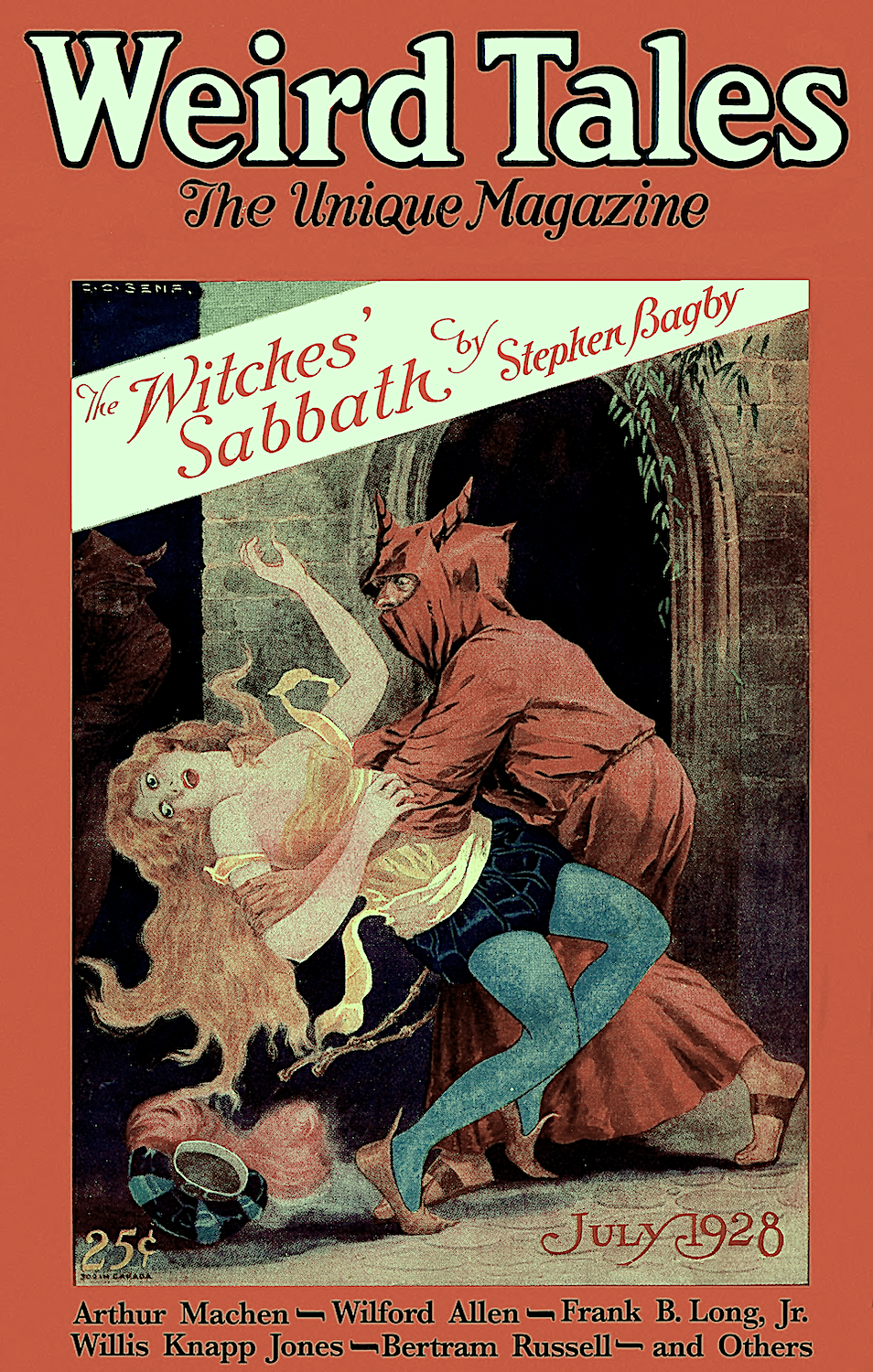
Weird Tales vol 12 number 01 (July 1928) - featured story: The Witches' Sabbath by Stephen Bagby.
#Literature #SciFi #ScienceFiction #books #bookstodon #coverart #bookart #bookcovers
#StephenBagby
@books @scifi @Scifiart @sciencefiction
Cover art by C. C. Senf.
Alt...
Weird Tales vol 12 number 01 (July 1928) - featured story: The Witches' Sabbath by Stephen Bagby. Cover art by C. C. Senf.
A humanoid figure and a wearing a coarse, textured brown hooded garment leans heavily over a pale-skinned woman. The woman is tilted backward in a limp posture, her head hanging down toward the bottom of the frame, displaying long, wavy light brown hair that cascades downward in thick, uneven strands. Her arms are raised and slightly bent at the elbows with fingers spread, and she wears a white, translucent fabric draped loosely over her torso and a dark blue skirt that falls in heavy, opaque folds around her legs. The hooded figure grips the woman's waist firmly with one hand, showing thick fingers, while the other hand, with visible white knuckles and darkened fingernails, is positioned near her upper body. The figure wears dark brown boots that reach mid-calf, featuring thick soles and rugged textures. The scene is set within a heavy stone archway constructed of irregular, grey blocks with visible cracks and rough, pitted surfaces, with dark, shadowy interiors visible behind the figures through the opening. Thick, green vines with small, pointed leaves and tangled, woody stems hang from the top of the stone structure, partially obscuring the upper edge of the masonry.
![[?]](https://files.mastodon.social/accounts/avatars/111/573/783/058/273/934/original/ff5639fc3a49047b.png)
Like, follow, and share if you love libraries, literacy, and books!
#library #libraries #read #reading #book #books #librarylove #author #publiclibrary #literature #lit

![[?]](https://files.mastodon.social/accounts/avatars/110/441/535/131/897/219/original/0ddf9d4dd12a5dee.png)